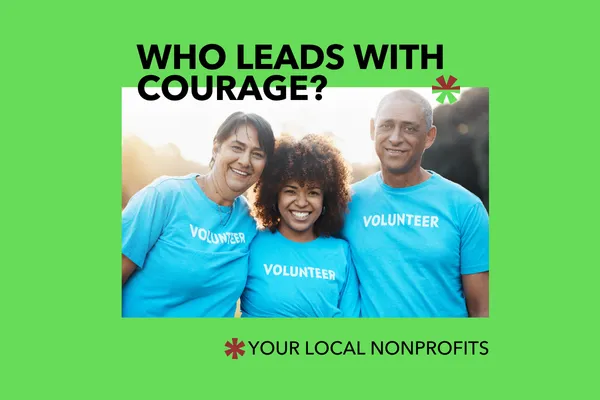
Courage Isn’t Reserved for Individuals — It’s the Currency of Community
In an era of funding insecurity and civic fatigue nonprofits feel isolated and experience analysis paralysis as they navigate shifting policy landscapes and shrinking resources. Taking risks may seem like the last thing we should do right now, but what if playing it safe was our biggest risk? Esteemed professor, author, and organizational leadership expert Ranjay Gulati says bold action begins with courage. He offers five leadership strategies in Now is The Time for Courage and suggests that leaders can create positive narratives to recast their work as moral quests. What if the nonprofit sector collectively adopted Gulati’s five principles to create positive narratives for our work? Here are five ways the nonprofit community can practice collective courage:
Create a positive narrative and lead with a shared moral vision. Frame your coalition’s work not just around service delivery and outputs, but around justice, dignity, and belonging.
Cultivate confidence through joint preparation. Host shared trainings, scenario planning, and real-time feedback loops. Courage grows when we feel capable and prepared—together.
Take small steps and tackle complexity in stages. Pilot. Learn. Pivot. Scale. Repeat. We do not have to solve everything at once—but we do have to start.
Find connection and invite cross-sector allies and critics to the table. Courageous coalitions welcome voices from all background and life experiences—especially community members who challenge us to think differently and do better.
Stay calm and care for the collective spirit. Celebrate wins together through shared meetings or organizational communications. Check in on burnout. Pause when needed. Remember, our strength is our sustainability.
The Courage Project—the United Way coalition that will grant $5 million in awards over the next year to nonprofits and individuals who stand up for their communities—is already reinforcing what research tells us: nonprofit coalitions are more likely to sustain long-term advocacy and impact than organizations working independently. Philanthropic thought-leadership echoes this too: Bridgespan’s Betting on the Tortoise argues that durable reform is built through sustained collective effort, not one-off campaigns.
This collective effort is precisely the ethos behind the One Sector, One Voice Triad (OSOVT), a joint initiative by the Guilford Nonprofit Consortium, Resilience High Point, and HandsOn Northwest North Carolina. The initiative draws nonprofit leaders and community members from the Piedmont Triad region in North Carolina to elevate the collective social, civic, and economic power of power of nonprofits—not as service providers alone, but as a unified voice for regional advocacy and transformation. OSOVT is supporting more than 700 nonprofits across the Triad through unified messaging, advocacy, and equipping nonprofit leaders to strengthen civic participation. OSOVT is helping build collective infrastructure that transforms plans into practice—across sectors, across boundaries, as civic co-creators.
Too often, funders spotlight individual heroes or episodic wins, and risk obscuring the ecosystems required for change. Evidence-based philanthropy shows impactful civic development happens when communities, not individuals, are the focus. So, our message is simple: invest in connective tissue—capacity building, convening, coordination—not just individual grantees or short-term projects.
Courage from the nonprofit community and philanthropic section can be difficult in today’s world where every dollar, every program, and every step toward a better community is scrutinized. It is replicable, however, and flourishes when many voices show up together as one. We can all challenge the default narrative that bravery belongs to a few. Instead, we can use a collective strategy and lead with moral clarity, prepare together, take bold steps even when we do not have a full picture, use a multidisciplinary team approach, and care for each other through empathy. Further, funders can provide multiyear infrastructure support to coalitions that transcend single-issue silos; policymakers can seek unified nonprofit delegations that represent shared regional priorities, not disparate requests; and nonprofit leaders can speak collectively—even when it is unfamiliar—and discover power in one voice.
It may start in a conference room—with 20 organizations asking, “What can we do together that no single one of us can?” The answer: adopt a low logo, low ego approach to cross-sector collaboration. To do so, however, requires the collective courage of the Triad community.

